
Description
The screw attack is seemingly one of Samus’ most powerful and devastating abilities, as well as one of her most iconic (as the series logo shares its logo with that of the ability’s icon). The screw attack is typically one of, if not the last power up that Samus finds in her various adventures, and for good reason. This powerup grants Samus the ability to project a field of electric potential energy around herself when spinjumping. Should any enemy be unfortunate enough to make contact with her in this state, they will be completely vaporized almost instantly, quite literally exploding in the process. This field also shields Samus from most sources of damage, making it both an incredible offence and an effective defence. Only a handful of enemies are unaffected by this bounty hunter turned spinning death machine, such as metroids (who can only be defeated through use of the ice beam).

Screw attack as seen in Metroid Zero Mission 
Screw attack vs enemies
Process
For this instance, I decided to do things a little differently. Rather than focusing energy as my endpoint, I wanted to take it a step further and calculate the theoretical voltage and current of the screw attack’s electric field in order to compare them with that of other large otputs of electrical energy (i.e. Lightning bolts). During my reasearch, I concluded that the best way to go about this would be to find energy first and work backwards from there. This was due to the fact that it was difficult to find how many volts it would take to vaporize a human (for obvious reasons). After some brainstorming, I had the idea to look into the cremation process.
For those unfamiliar, cremation is the process of heating a deceased body to such a temperature that it is reduced into bone fragments and skeletal remains, which are then pulvarised into dust. I wanted to find out at what temperature a body is heated to during the process. Using that data in combination with the estimated mass of a reference enemy and the specific heat capacity of the human body, I could find the energy it would take to reduce a body to ash. More specifically, I could find the energy it would take to heat a body to that temperature, at which point anything un-vaporized would likely be destroyed by the subsequent explosion created by releasing such a large amount of energy in such a short time. According to cremationresource.org, a body is typically heated anywhere between 1400-1800 degress Fahrenheit (approximately 760-982 degrees Celsius). For argument’s sake and to ensure that the body is completely disintegrated, we will take the higher end of this range.
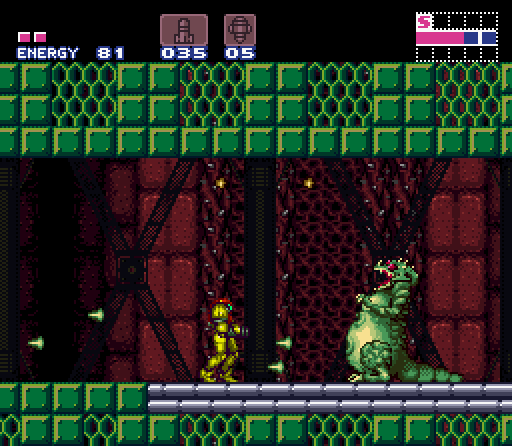
Mini Kraid compared to Samus
For the variable of mass, I took the largest enemy I could find that Samus was able to vaporize with the screw attack, as larger mass would require more energy to vaporize it. The particular enemy I chose was mini Kraid, an enemy you encounter only once in the entire game. To find his approximate mass, I first needed his height. Looking at his sprite, mini Kraid stands at 62 pixels tall, comparing that to Samus’ in-suit height of 1.91 meters (48 pixels) we can calculate that mini kraid is approximately 2.45 meters tall (which would fit as he is seemingly about 1.5x taller than Samus)

Now that I had his height, I could find his mass. To do so, I took a look at a chart that documents average human weight range relative to height (female onleft, male on right). I ran some tests in which I took the ratio between a larger height and a smaller height (divided a larger height by a smaller height) and multipled weights within the range of the smaller height by that ratio. After some testing, I found that when I used the largest weight within the range of the smaller height, my result was always in the middle of the range of the larger height (about 10 kg from either extreme). If that all seems confusing, allow me to put it in context. If I take mini Kraid’s height of 2.45 meters and divide it by a height on the chart (we’ll use 2.13 meters) I get a ratio of approximately 1.15. This means that mini Kraid is about 1.15x taller than 2.13 meters. From here, I multipled the largest male weight in the range of 2.13 meters (124.7 kg) by that ratio, yielding a result of approximately 145 kg. Based on my testing, I know that this resultant mass is 10kg from both the maximum and minimum average weight for someone of mini Kraid’s height. Given that mini Kraid is seemingly on the heavier side based on his sprite, we’ll say he has a mass of approximately 155 kg.

To further support this assumption, I took a look at a graph that details body mass index based on height and weight. While the chart only includes heights up to and including 2.0 meters, we can approximate based on the trend of the lines, that the overweight/obese ranges would likely be around 150-160 kg. Looking again at mini Kraid’s sprite, I feel that it is safe to say that he isn’t in peak physical condition. In layman’s terms, mini Kraid is definitely fat. As upset as I’m sure he would be to hear that, it won’t matter as he is about to be turned into a hot pile of ash. Now that we have his mass, we can calculate how many joules of heat it would take to turn him into said pile of ash.
Recalling that Q=mcΔT (where Q is heat energy, m is mass, c is specific heat capacity, and ΔT is change in temperature), we can calculate how much energy it would take to get him to 982 degrees celsius. We’ll assume that mini Kraid shares an average body temp and specific heat capacity with those of a human (37 degrees celsius and 3500 J/kgK respectively). It should also be noted that latent heat would not be used here as the object in question is not changing state, only being reduced to more basic compounds. Plugging all of these values in, we get a result of approximately 512,662,500 joules (or just over half a giga joule) of heat energy. That’s just over half the amount of energy contained in an average lightning bolt. While that may not seem like it adds up since lightining has no recorded instances of vaporizing a human, it should be noted that not all of the energy contained in a bolt of lightining would be concentrated into a person if they were struck. Impressive as that energy output is, I mentioned before that I wanted to take this a step further and find voltage and current.
To do this, I first needed to find power. Power is equal to change in energy over time (P=ΔE/Δt). To find time, I used the same frame advancing technique that I used for the speed booster to calculate how many frames it takes for the enemy to be killed by the screw attack. After some testing, I found that it takes 4 frames from contact for the enemy to be vaporized. Recalling that Super Metroid runs at 60 fps, that would make the change in time approximately 0.067 seconds, which results in a power output of approximately 7,651,679,104 watts. If Samus were to run her screw attack for 24 hours, she would output enough power to power all of New York City for 17 days, and all of that is being expended to turn a single foe to dust and bone in a fraction of a second. Moving on, now that we have a value for power we can find voltage and/or current based on the average resistance of the human body. According to a document on worker deaths by electrocution written by the National Institute for Occupational Safety and Health (NIOSH), the average ohm resistance of the human body is approximately 100,000 ohms. However, the same document also states that when wet, the resistance can drop as low as 1000 ohms. Given that mini Kraid resides in brinstar, which happens to be an area with lots of vegitation; the climate would be very humid. Moreover, we concluded in a previous post that the concentration of water vapor per mole of Zebes’ atmosphere is far greater than that of earth. One last detail from the document should be noted as well. It states that as the skin is broken by high voltages, the resistance of the human body drops to about 500 ohms. With all that information in place, we’ll use an average between 1000 and 500, giving us an average resistance of 750 ohms.
Final Calculations
All that remains now is to do the calculations for voltage and current. In terms of resistance and voltage, power is equal to the square of voltage divided by resistance. We can arrange this to find voltage, giving us an equation of V=sqroot(PR) (where V is voltage in volts, P is power in watts, and R is resistance in ohms). Substituting in all our values, we get a voltage of approximately 2,395,571 volts. To give that some context, The National Aeronautics and Space Administration (more commonly known as NASA) detail the average voltage deliverance of a lightining strike on a human is approximately 300 kilovolts (300,000 volts). Therefore, while the screw attack doesn’t beat lightning for energy output or power, it yields more voltage when striking a human.
As for current, Ohm’s law states: V=IR (where I is current in amps, V is voltage in volts, and R is resistance in ohms). Since we have V and R, we can calculate current to be approximately 3200 amps. For use as a weapon this is definitely overkill, as currents as little as 0.1 amps can be lethal to a human. All things considered, I think it’s safe to say that next to nothing is going to survive this ridiculous weapon.
Results
To recap, the screw attack would theoretically output approximately 512,662 kilojoules (approximately 123 kilograms of TNT). That amount of energy released in 4 frames (approximately 0.067 seconds) gives it a power output of approximately 7,652 Megawatts. Multiplying that by 24 gives us approximately 184,000 Megawatt-hours, which as mentioned before, is almost 17x the amount of power consumed by all of New York City in the same time frame. Using our average resistance of 750 ohms gives us a voltage of approximately 2,396 kilovolts and a current of 3200 amps. While lightnining can carry a voltage of up to a gigavolt (1,000,000 kilovolts), as mentioned previously, lightining striking a human only delivers about 300 kilovolts (which would give it a current of approximately 400 amps in this particular instance).
While the results aren’t quite as high as the ice beam (645MJ vs 513MJ), it is still extremely impressive. Moreover, recall that the ice beam needs to absorb so much energy from the air due to the higher pressure on Zebes. Given that this is just one of her many abilities, it’s crazy to imagine just how much energy her suit would need to produce and just how she produces it. However, that is a question for another time. The next and final ability on the list, is the gravity suit
 The Physics of Super Metroid